Defense Innovation

How Drone Swarm Tactics Are Becoming The New Norm For U.S. Soldiers

U.S. Army Drone Operator Trains with Loitering Munition in grassy area

The U.S. Army has established a new standard in robotic combat, with soldiers now proficiently controlling up to 21 small drones and four large autonomous vehicles simultaneously. Recent exercises at Fort Bragg’s Sandhills Project demonstrated this “swarm warfare” capability, designed to overwhelm enemies and shift engagements towards robot-on-robot combat. Troops utilized Bumblebee V2 drones and a semi-autonomous Ford F-250 equipped with a 12-gauge shotgun turret for safe anti-drone defense. This force multiplication strategy, accelerated by direct soldier-industry collaboration, enables smaller units to achieve greater impact, conduct elaborate deception operations, and significantly reduce human risk. The Army confirms swarm tactics are no longer future concepts but the present reality, ushering in an era of machine-centric battles.

How Drone Swarm Tactics Are Becoming The New Norm For U.S. Soldiers Read More »

Partnership Between US Army JIOP & Catalyst Pathfinder Program Fostering Soldier-Driven Innovations

Blue background with title: Partnership Between US Army JIOP & Catalyst Pathfinder Program Fostering Soldier-Driven Innovations Executive gov logo and DEVCOM logo

The U.S. Army’s LTG James M. Gavin Joint Innovation Outpost, or JIOP, is compressing the timeline between a soldier’s idea and a fielded capability, delivering several equipment capabilities to the XVIII Airborne Corps through a partnership with the Combat Capabilities Development Command’s Army Research Laboratory Catalyst Pathfinder program, according to the U.S. Army DEVCOM Army Research Laboratory Public Affairs Office.

Partnership Between US Army JIOP & Catalyst Pathfinder Program Fostering Soldier-Driven Innovations Read More »

President’s Commentary: The Road to a Perpetual State of Modernization

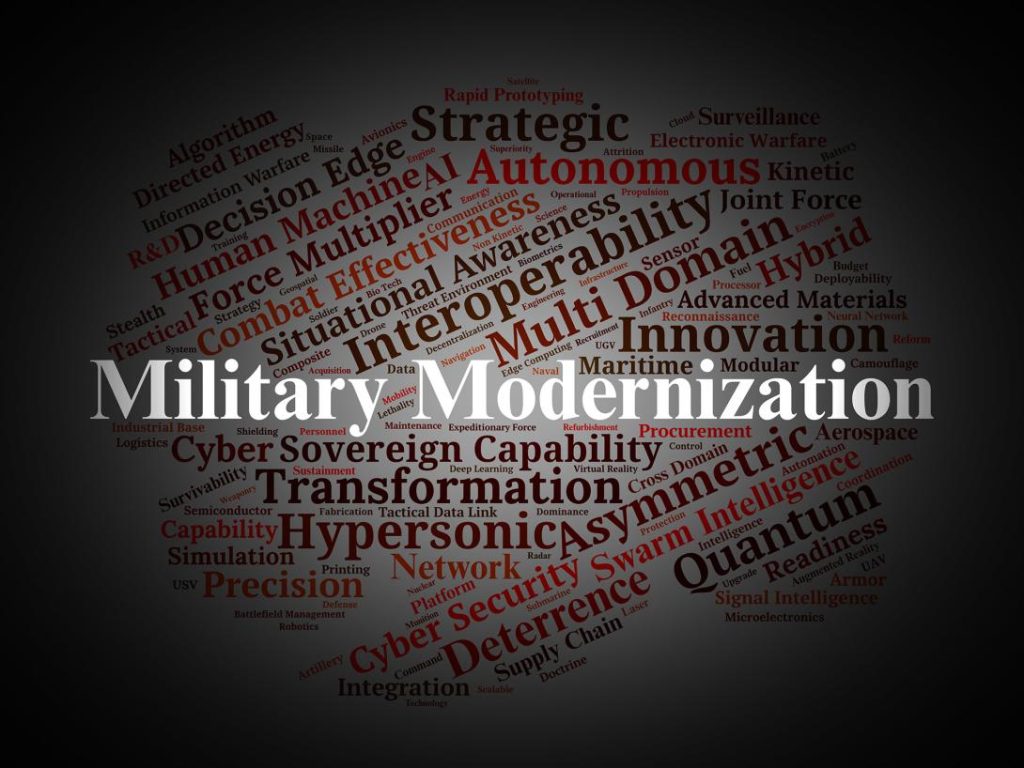
Word cloud with "Military Modernization" in white in the foreground with a gradient black background.

From space-based capabilities and autonomous weapons to the strategic use of artificial intelligence, it is clear from the actions of our military departments and federal agency leadership that today’s modern battlefield has shifted dramatically and is rapidly evolving. Military advantage belongs to those who rapidly field and integrate new capabilities. And as our adversaries closely track our capabilities, maintaining momentum with a perpetual state of modernization is not optional; it is imperative.

President’s Commentary: The Road to a Perpetual State of Modernization Read More »

G-TEAD USARPAC ACE 27-01: Advancing Autonomous Sustainment in the Pacific 

G-TEAD USARPAC ACE 27-01: Advancing Autonomous Sustainment in the Pacific Web card with G-TEAD logo

WASHINGTON ‒ The Global Tactical Edge Acquisition Directorate (G-TEAD), in partnership with U.S. Army Pacific (USARPAC), and powered by Army FUZE xTech, has launched the G-TEAD USARPAC ACE 27-01: Autonomous Sustainment powered by xTech competition to accelerate innovative sustainment solutions for distributed forces operating across contested island chains. 

G-TEAD USARPAC ACE 27-01: Advancing Autonomous Sustainment in the Pacific  Read More »

Department of War Issues Final FY26 APFIT Awards, Surpassing $2 Billion Milestone and Debuting Software Capabilities

Department of War Seal

The Department of War today announced a new round of awards under the Accelerate the Procurement and Fielding of Innovative Technologies (APFIT) program, marking a major milestone as the program surpasses $2 billion in total awards since its inception.

Department of War Issues Final FY26 APFIT Awards, Surpassing $2 Billion Milestone and Debuting Software Capabilities Read More »

U.S. Army Launches Five New Funding Opportunities for Small Businesses

ManTech team stands on stage posing for picture of acceptance of DMTAA award

The U.S. Army has announced five distinct funding opportunities for small businesses through its Army FUZE Small Business Innovation Research (SBIR) and Small Business Technology Transfer (STTR) initiatives, following the news that SBIR|STTR has been reauthorized by U.S. Congress. As a pillar of the Army FUZE portfolio, SBIR|STTR opportunities help small businesses break through the typical barriers of working in government research and development by opening doors to sustained funding and clear transition pathways.

U.S. Army Launches Five New Funding Opportunities for Small Businesses Read More »

Scroll to Top