
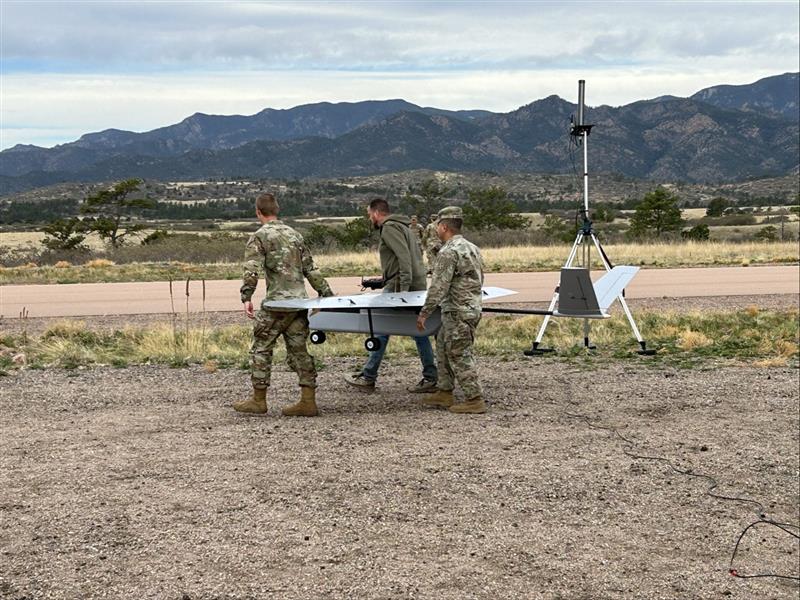
In a demonstration of collaboration and innovation, a team of Army civilians, technology experts, and Soldiers converged at Fort Carson for a week-long series of validation experiments in April 2026.
05/13/2026
Modernization Technology Transition Transformation in Contact Warfighter Readiness TMI
By Anna Volkwine, Office of Army Pathway for Innovation and Technology (PIT)
In a demonstration of collaboration and innovation, a team of Army civilians, technology experts, and Soldiers converged at Fort Carson for a week-long series of validation experiments in April 2026. The event, held at the rugged Fort Carson Tactical test ranges, showcased the Army Pathway for Innovation and Technology’s (PIT) commitment to bridging the gap between commercial technological advancements and enduring military capability. This effort highlights the mission of TMI – recognizing that while the commercial sector offers a wealth of innovation, advantage is achieved when these technologies are deliberately adapted, hardened, and integrated for the unique demands of Army operations.
As a strategic investment vehicle for Army modernization, TMI reduces technical risk, prioritizes Soldier touchpoints, and propels prototypes across the “Valley of Death.” TMI ensures that these systems evolve from promising commercial prototypes into battle-ready assets.
Technology Integration Field Experiment and Soldier Touchpoint Exercise
Operating in challenging environmental conditions, the experiments pushed the boundaries across several key technology portfolios, proving out prototype capabilities designed for contested environments.
Among the successes was the modular Unmanned Aerial Systems (UAS) advancement led by the Critical Common Core Electronics for UAS TMI team, successfully demonstrating a highly flexible, modular approach to drone configuration. Soldiers from the 4th ID swapped hardware, such as motors and cameras, between fixed-wing and quadrotor platforms. They flew five different payloads that included gimbal cameras, infrared imagers, and various radio frequency configurations.
Advancements in next-generation communications and cellular command and control also took center stage. The Multi-Net TMI team achieved critical milestones by validating a 5G Sidelink that broadcasted PLI from a UAS to multiple ground nodes while simultaneously relaying voice communications. They successfully integrated the Multi-Net hardware into a Tactical Scalable Mobile Ad Hoc Network (TSM) mesh network, proving the ability to securely transmit data and extend battlefield networks between advantaged and disadvantaged nodes. Complementing this effort, a separate TMI initiative integrated modified commercial UAS platforms with a variety of command and control payloads, utilizing both 5G Sidelink and TSM narrowband.
The event also prioritized advanced sensor validation. Under a separate prototyping project, two acoustic sensors completed their final validation experiments, where the team proved out multiple data transport options to ensure intelligence can be reliably pushed to cloud storage and available across multiple echelons.

Innovation in Action
The catalyst for this rapid maturation was the real-world experimentation environment and the direct integration of the end-user. Led by the TMI team alongside the Combat Capabilities Development Command Army Research Lab and Capability Program Executive Command and Control Information Network, the experiments stress-tested prototype hardware outside the confines of a traditional laboratory.
Approximately 40 onsite experts partnered with a small UAS platoon from the 4th ID and members of the 10th SFG. These developers worked shoulder-to-shoulder with the Soldiers, training them on the systems and collecting exhaustive performance data. By putting prototype equipment directly into the hands of Soldiers who will ultimately rely on it in the field, the developers gained the most critical metric of all: unfiltered, hands-on user feedback regarding deployment, usability, and resilience under pressure.
Strategic Impact
TMI serves as a vital engine for modernization, ensuring that the Army can capitalize on the speed of commercial innovation without sacrificing the reliability required for multi-domain operations. By bringing developers out of the lab and into the field and bridging critical funding gaps, the Army is aggressively accelerating the maturation process and identifying areas for improvement early in the development lifecycle.
The strategic impact of this event is already materializing. For example, the TRACEComms Accelerate the Procurement and Fielding of Innovative Technologies team utilized the event to gather valuable user input on a surrogate UAS platform and early versions of their command, control, and navigation electronics. This feedback is informing vital improvements to their flight simulator and mission planning tools and will shape the first hardware deliverable expected in summer 2026.
Ultimately, this iteration of field experiments ensures that as commercial technologies are adapted for military use, future transitions will provide a resilient, proven, and decisive advantage to the warfighter.