
Update
4 min read
September 15, 2026
Army Selects Five xTech|Inversion Winners to Advance Army-Developed Technologies
xTech Continuous Transformation Defense Innovation Discovery Streamlined Acquisition
By Eleanor Kent, Army FUZE
AUSTIN, TX — Last month five small businesses were selected as winners of xTech|Inversion, advancing an Army effort that opened government-developed intellectual property to commercial innovators and challenged industry to find new ways to turn that technology into viable capabilities.
Led by the Army FUZE xTech Program in partnership with the Office of the Deputy Under Secretary of the Army (DUSA) and the Deputy Assistant Secretary of the Army for Research and Technology (DASA (R&T)), xTech|Inversion expanded the Army’s approach to engaging industry. Rather than scouting the commercial market for technologies that address Army needs, the competition gave U.S. small businesses access to select technologies developed across the Army research enterprise and invited them to apply their own technical, product-development and market expertise to determine where those investments could go next.
The Army made 16 intellectual property sets available through the competition, spanning chemical detoxification and water treatment, infrared sensing and measurement, space-based positioning, navigation and timing, filtration, power generation and conversion, advanced fuels and materials, and expeditionary infrastructure. Companies were asked to propose not only technical applications for the Intellectual Property (IP), but commercialization strategies and transition pathways capable of carrying the technology beyond its original research environment.
The competition drew more than 200 white paper submissions, reflecting industry interest in working directly with Army-developed technology. Twelve companies were selected as finalists, each receiving $20,000 and entry into the xTech Accelerator program. Through six workshops and individualized advisor support, finalists refined their commercialization strategies, prepared their pitches for Fed Supernova 2026, navigated licensing considerations, and developed plans for potential Army Small Business Innovation Research follow-on work.
Those efforts culminated at Fed Supernova in Austin, Texas this past month, where the 12 finalists presented their approaches publicly over two days to Army and Department of War (DoW) experts. The pitches put a central question behind xTech|Inversion to the test: could commercial innovators identify new applications, markets, and transition opportunities that broaden the potential utility of Army technology?
“I was really impressed by all the teams that gave pitches,” said Ann Marie Martin, technology transfer lead with the Army Research Laboratory (ARL), which developed the foundational IP used by two of the winning companies. “They were well coached through the xTech Accelerator, delivered strong pitches, and brought the Army IP to life in a commercial realm that may not have been considered before, creating opportunities to support the Army and generate broader economic value.”
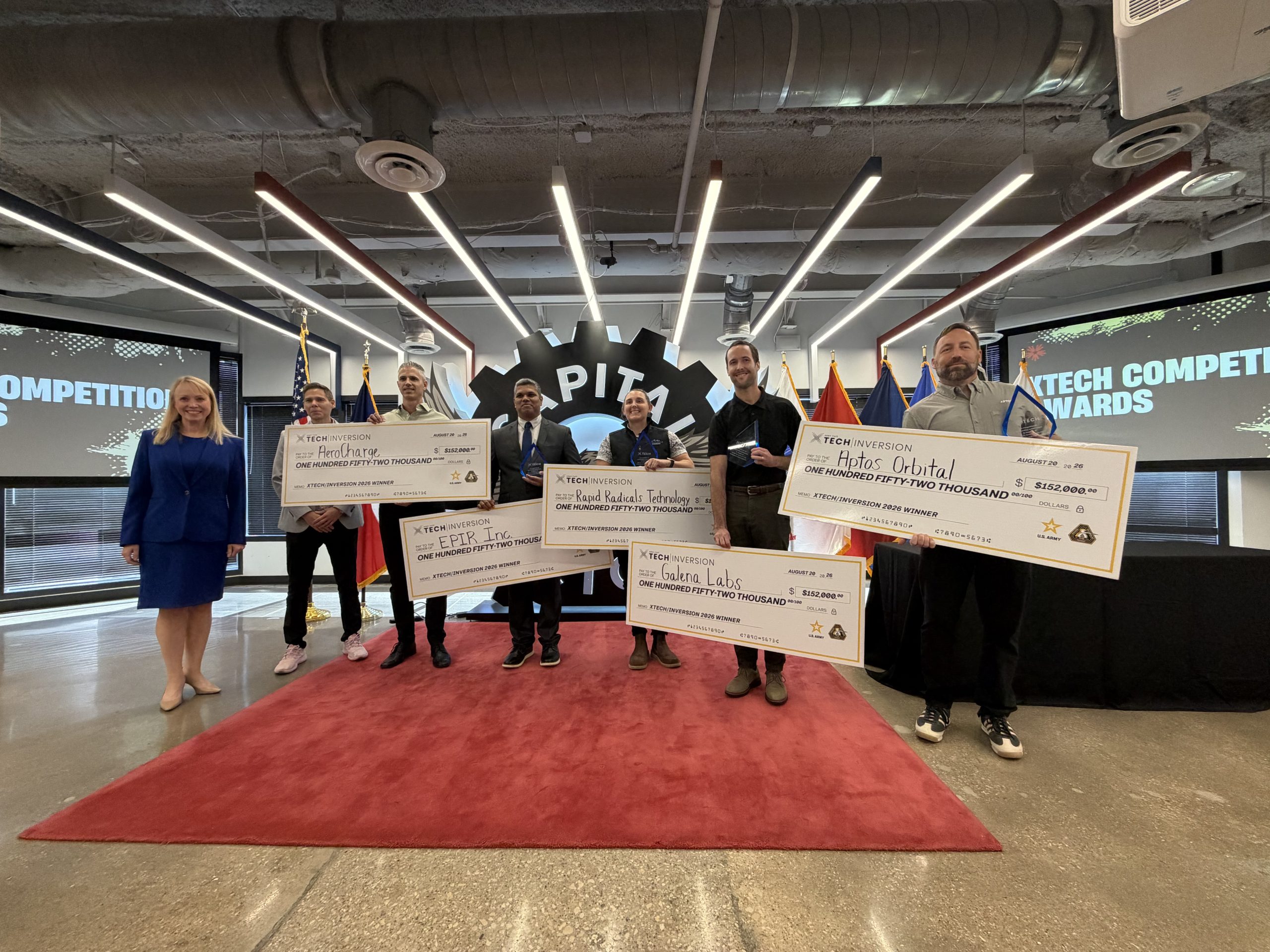
Five companies were selected as winners, each receiving an additional $152,000 and the opportunity to submit a Phase I Army Small Business Innovation Research (SBIR) proposal worth up to $300,000 to further develop their proposed application. The winning approaches include:
- AeroCharge — RF-powered Asset Network for Greater Energy and Range (RANGER) | IP Set 12 from DEVCOM Army Research Laboratory from DEVCOM ARL
- Aptos Orbital — PROJECT SPEAR: Space-based PNT Edge Atmospheric Resilience | IP Set 6 from DEVCOM Armaments Center (AC)
- EPIR Inc. — Deformable Auxetic Focal Planes for Ultra-Wide Field-of-View Thermal Perception | IP Set 10 from DEVCOM Army Research Laboratory
- Galena Labs (Wellbot) — Autonomous Rehabilitation for Critical Water Infrastructure | IP Set 13 from Engineer Research and Development Center (ERDC)
- Rapid Radicals Technology — MOF-enhanced Torrent3 system for waterborne chemical threat neutralization | IP Set 3 from DEVCOM Chemical Biological Center (CBC)
The five winning approaches show the range of potential outcomes from opening Army IP to industry. Technology originally developed around low-voltage power conversion is being considered as part of an RF-powered asset network. Army research in ionospheric correction is being applied to space-based PNT resilience. Other winning concepts address wide-field-of-view thermal perception, autonomous maintenance of critical water infrastructure and neutralization of waterborne chemical threats.
That breadth matters to the Army. Research and development can produce valuable technologies without guaranteeing that every invention will find its way into a program, product or operational capability. By exposing select Army IP to companies with different technical backgrounds, commercial markets, and product strategies, xTech|Inversion gives the Army another way to identify potential uses for its research while creating an entry point for small businesses that may not otherwise have had access to those technologies.
The approach also aligns with a broader effort to reduce the distance between the Army’s research enterprise, acquisition community, and commercial innovators—removing friction that can keep promising technology from reaching Solders at the pace the mission demands.
“The exponential growth of the xTech program is demonstrative of recognizing that, despite being in acquisition and government, we can actually move quickly when we have senior leaders who are willing to take risk,” said Dr. Matt Willis, director of Army FUZE, in reference to xTech’s role within the Pathway for Innovation and Technology. “We can’t let process or bureaucracy get in the way of innovation.”
For xTech|Inversion, the winner announcement begins the next test of that approach.
The five companies will continue receiving tailored support through the xTech Accelerator program as they prepare SBIR proposals and work toward agreements with the Army laboratories associated with their respective technologies. If awarded, the Phase I SBIRs would fund up to six months of proof-of-concept work, moving the winning concepts from commercialization strategy into technical execution.
The next phase shifts the measure of success from strength of a commercialization case to what companies can prove through technical development. For the Army, it is also a test of a broader proposition behind xTech|Inversion: whether giving industry greater access to government-developed technology can create additional routes for Army research to move out of the laboratory, attract outside investment and expertise, and ultimately deliver greater return from the Army’s science and technology portfolio.